

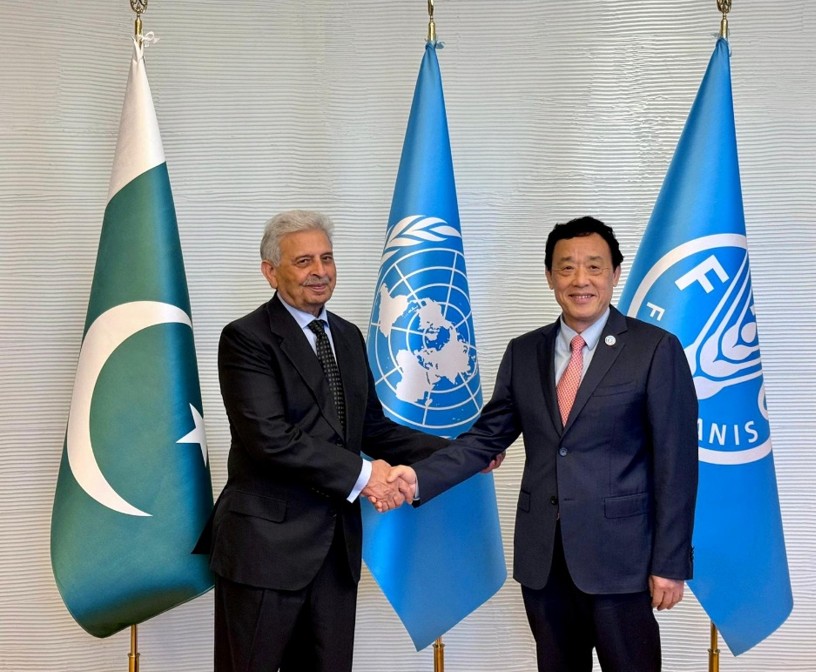
ISLAMABAD, Dec 5 – Pakistan highlighted China’s agricultural development models on the international stage during a high-level meeting between Federal Minister for National Food Security & Research Rana Tanveer Hussain and FAO Director-General Dr. Qu Dongyu at FAO Headquarters in Rome.
According to an official statement, during the “hour-long substantive bilateral discussion,” the Minister expressed satisfaction over his participation in the 179th FAO Council and praised the “trajectory of excellent bilateral cooperation with FAO,” Gwadar Pro reported.
Hussain “highlighted challenges and opportunities emerging from climate change” and emphasized the need for “climate-resilient practices in agricultural productivity, water management, seeds, cutting-edge infrastructure, and strengthened research and innovation.”
A central theme of the meeting was Pakistan’s commitment to learning from Chinese agricultural innovations. The Minister “welcomed deeper FAO technical support and expressed interest in learning from successful models, particularly China, in precision agriculture, intercropping, cooperative farming, geographical indication (GI) products, digital farm management, and food safety standardization.”
China’s advances in digital agriculture, cooperative farming frameworks, and food safety standardization have positioned it as a global trendsetter—capabilities Pakistan aims to adopt as it accelerates agricultural modernization.
Dr. Qu Dongyu “conveyed commitment for close cooperation in ‘Development Research’ as means to a long-term strategy to mitigate challenges” and encouraged Pakistan to prioritize “high-impact investments over short-term spending.”
The Minister thanked FAO for its support, noting Pakistan’s intention to “prioritize transformative projects that deliver lasting benefits to farmers and rural communities.”
The two sides also “discussed best practices in smallholder farming, local food systems, and green rural development,” agreeing that “targeted investment in research… may significantly boost farmer incomes and food security.”
The meeting in Rome came shortly after Pakistan initiated a major restructuring of the Pakistan Agricultural Research Council (PARC) in early November under a Strategic Reform and Cooperation Plan developed with China’s Ministry of Agriculture and Rural Affairs (MARA) and the Chinese Academy of Agricultural Sciences (CAAS).
The reform agenda aims to transform PARC into a modern, innovation-driven institution through the establishment of Technology Transfer Units (TTUs), a National Agricultural Technology Transfer Center, and regional demonstration hubs.
These steps are designed to accelerate the adoption of Chinese agricultural technologies, ensuring that scientific research translates into tangible productivity gains and value addition for farmers across Pakistan.
