

By Ramesh Raja
Pakistan’s development narrative is not defined by a lack of construction, but by the premature failure of what has already been built. Roads, bridges, buildings, sports complexes, water supply schemes, drainage networks, and even mega infrastructure projects begin to deteriorate soon after inauguration. The fundamental cause is neither weak engineering nor absence of planning; it is the systematic elimination of maintenance from our national mindset, governance, and post-construction practice. As a nation, we glorify construction while abandoning upkeep, resulting in unsafe infrastructure and massive wastage of public resources.
*Maintenance: A Core Concept on Paper, Abandoned in Reality*
In basic planning doctrines and standard project documentation, maintenance is treated as a core operational requirement. Feasibility studies, PC-I documents, and financial models explicitly include operation and maintenance (O&M) provisions. Taxes, tolls, and user charges are imposed on the public precisely to ensure continuous, safe, and efficient operation of infrastructure.
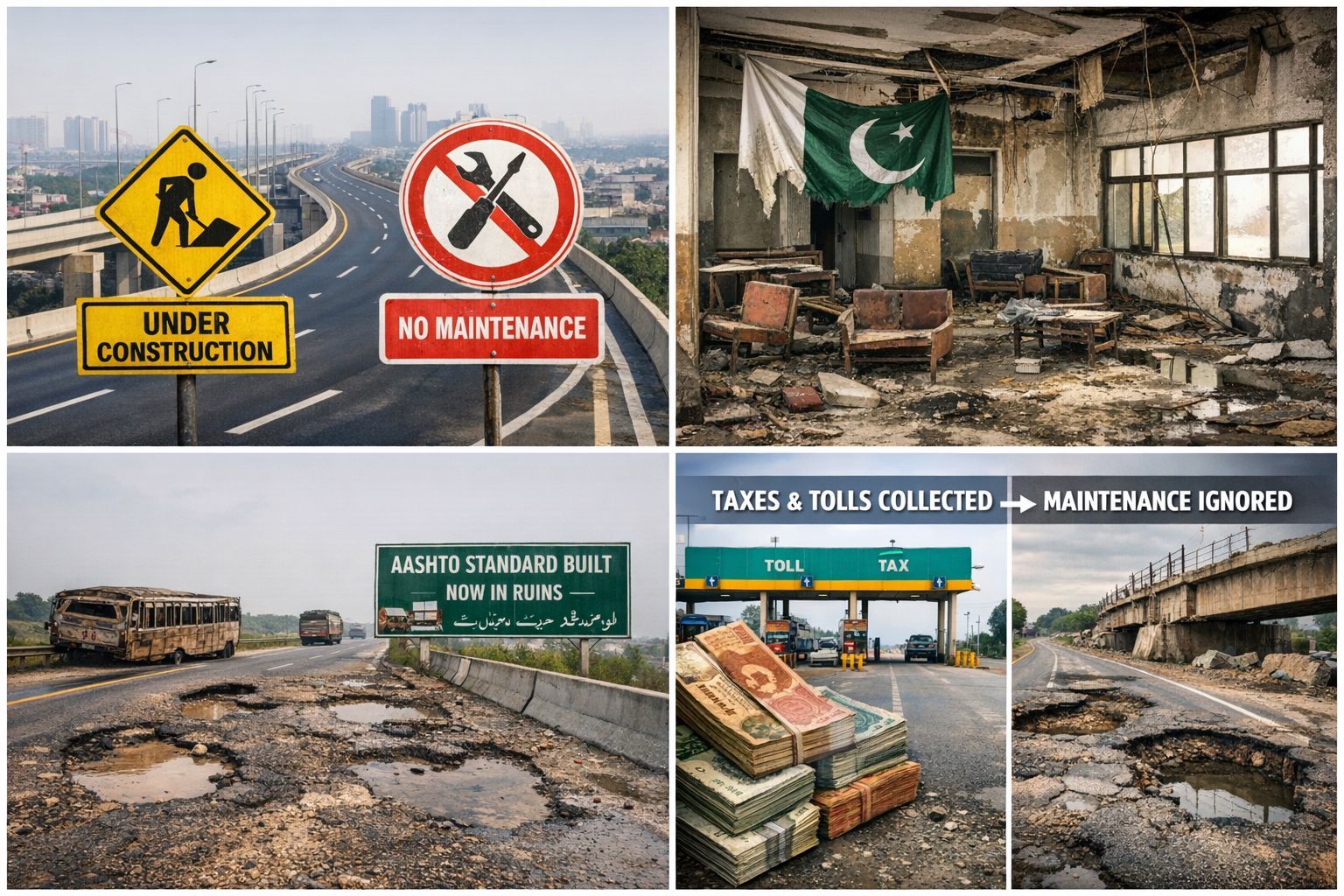
Yet, in practice, these provisions are rarely honored. Taxes continue to be collected diligently, toll plazas operate efficiently, and user charges are enforced strictly—but the funds meant for maintenance are not utilized for their intended purpose. Instead, maintenance allocations are either delayed, curtailed, or diverted, leaving assets to decay unchecked. This persistent gap between planning and execution is at the heart of our infrastructure crisis.
*World-Class Construction, Zero Maintenance*
Ironically, Pakistan has made significant progress in adopting international construction standards and modern practices. We follow global design codes, employ qualified engineers, and use advanced machinery, equipment, and construction plants. Highways and motorways are being constructed on AASHTO standards, comparable to those in developed countries. From earthwork and pavements to bridges and interchanges, the construction quality itself is often sound.
However, infrastructure built to international standards cannot survive without international-level maintenance. Roads designed for decades of service begin to fail within a few years because routine and preventive maintenance is ignored. Despite proper collection of tolls and taxes meant specifically for upkeep, maintenance remains neglected, leading to premature distress, safety hazards, and eventual failure. Thus, even globally compliant projects become short-lived liabilities.
*A National Culture of Neglect*
This failure is not confined to institutions alone; it reflects a deep-rooted societal behavior. From neglected homes and public spaces to decaying state assets, preventive care is culturally undervalued. Temporary repairs replace systematic upkeep, and breakdown maintenance becomes the default response. When this mindset governs national infrastructure, failure becomes inevitable.
*Visible Failures Across Sectors*
The consequences of neglect are evident everywhere:
* Public Buildings and Sports Complexes: Newly inaugurated facilities become dysfunctional due to broken utilities, leaking roofs, and lack of routine care.
* Water Supply Schemes: Pumps fail, pipelines leak, filtration plants shut down over minor faults that go unattended.
* Drainage and Sewerage Systems: Unmaintained drains clog, causing urban flooding and serious public health risks.
* Roads and Highways: Potholes, rutting, and surface failures appear soon after completion, increasing accidents and transport costs.
* Mega Projects: Billion-rupee projects, despite sound design and construction, deteriorate prematurely due to absence of performance-based maintenance.
These are not isolated incidents; they are systemic outcomes of neglecting maintenance.
*Economic and Governance Costs*
Ignoring maintenance results in:
* Premature asset failure
* Repeated reconstruction instead of preservation
* Escalating safety risks
* Service disruptions
* Loss of public trust
* Enormous financial waste
Globally, preventive maintenance is recognized as far cheaper than rehabilitation or reconstruction. Pakistan’s failure to internalize this principle keeps the country trapped in a costly cycle of build–neglect–rebuild.
*Measures for Reform: From Construction State to Maintenance State*
To break this cycle, Pakistan must undertake structural reforms:
1. National Maintenance Policy
Enact a legally binding National Maintenance Policy making maintenance compulsory throughout the asset life cycle.
2. Ring-Fenced Use of Taxes and Tolls
Taxes, tolls, and user charges collected for infrastructure must be legally protected and used exclusively for O&M purposes.
3. Performance-Based Maintenance Contracts
Shift from activity-based to performance-based maintenance, linking payments to measurable service standards.
4. Life-Cycle Costing as Law
Make life-cycle costing mandatory in project approvals to prevent short-term construction decisions with long-term losses.
5. Independent Asset Management Framework
Establish autonomous asset management authorities to monitor condition, plan maintenance, and publish performance reports.
6. Audit, Transparency, and Parliamentary Oversight
Maintenance expenditures must be audited with the same seriousness as development spending, with clear legislative oversight.
7. Cultural Transformation
Promote maintenance awareness through education, professional training, and public campaigns to build a national ethic of care.
Pakistan’s infrastructure crisis is not caused by lack of engineering expertise, modern machinery, or international standards. It is caused by the deliberate neglect of maintenance despite continuous tax and toll collection. Until maintenance moves from paper to practice, and until revenues collected in the name of safe operations are actually spent on upkeep, projects—no matter how well designed—will continue to fail prematurely.
True development is not about how many highways, buildings, or mega projects we inaugurate; it is about how long and how safely they serve the people. Without enforceable maintenance laws, protected funding, and a cultural shift, Pakistan will remain locked in a cycle of impressive construction followed by inevitable collapse—an outcome no nation aspiring for sustainable development can afford
