
When Urban Life Struggles to Breathe Amid Civic Neglect
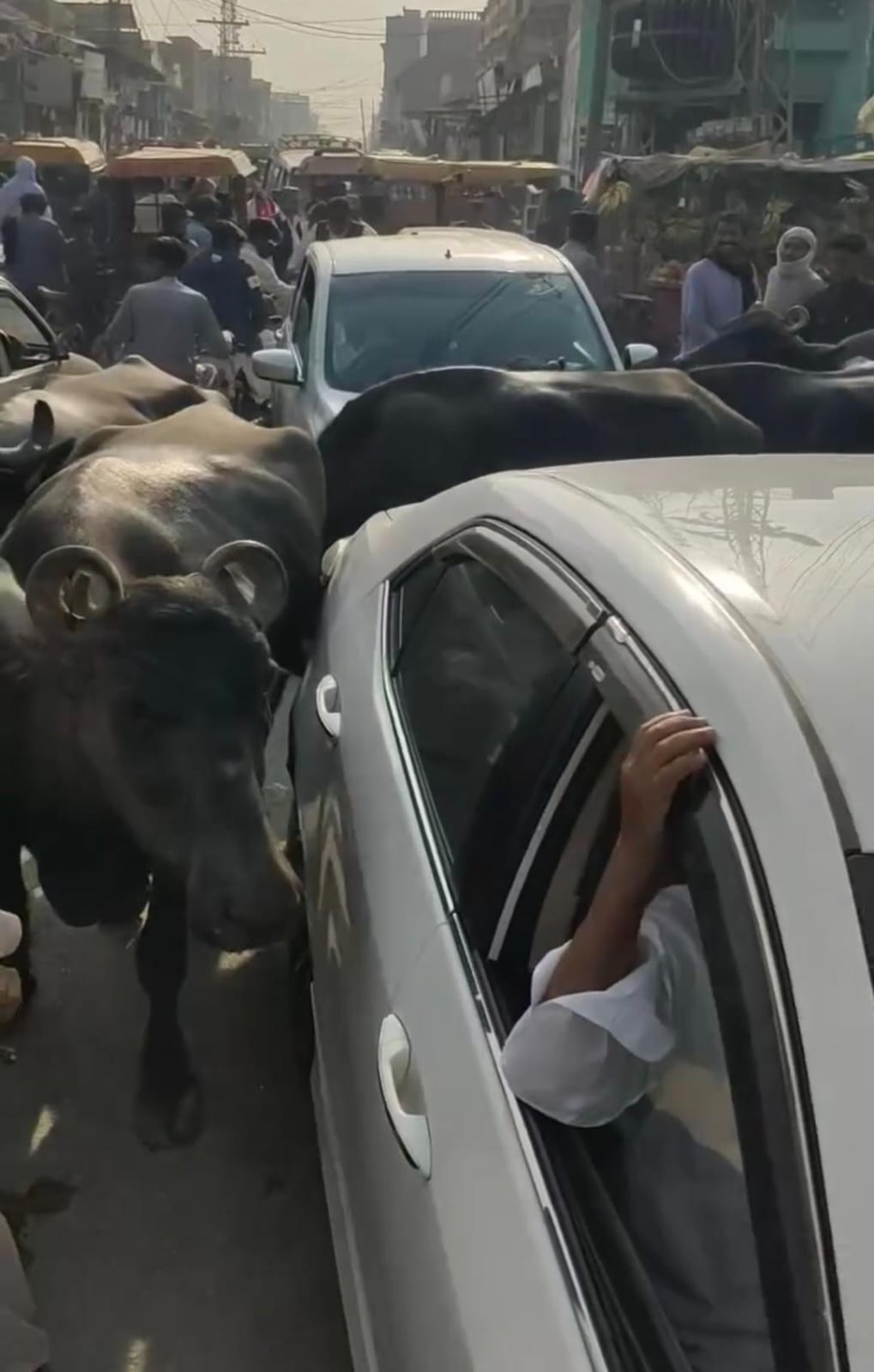
Larkana neighbourhoods, streets meant for people have gradually turned into informal cattle enclosures, where buffaloes roam freely, traffic crawls.

By Mehmood Ali Pathan
LARKANA: Once envisioned as a planned and livable urban centre, today presents a troubling picture of civic decay that residents say has become impossible to ignore. In many neighbourhoods, streets meant for people have gradually turned into informal cattle enclosures, where buffaloes roam freely, traffic crawls, and daily life is overshadowed by stench, congestion and health concerns.
Across large parts of the city, residents complain that roads remain layered with animal waste, drainage lines are frequently choked, and sewerage overflows have become a routine sight rather than an emergency. What was once considered temporary mismanagement now appears to many citizens as a prolonged failure of urban regulation.
For shopkeepers, students, women, elderly residents and patients travelling to hospitals, the situation is more than an inconvenience. We walk pressed against walls to avoid animals and filth, said Molana Afzal Tahiri a resident of an inner city locality. This is not how an urban population should be living in the 21st century.
The problem is not new. In 1977, former prime minister Zuilfikar Ali Bhutto announced the establishment of a cattle colony outside the city after listening to public complaints, with the aim of relocating livestock activity and making Larkana safer and cleaner for human habitation. Nearly five decades later, however, buffaloes remain inside residential areas, raising questions about implementation, continuity of policy, and political will.
Environmental damage has also become a growing concern. Citizens allege that sections of the Rice Canal embankment are being damaged for animal bathing, weakening infrastructure and threatening water management. Waste from cattle sheds frequently finds its way into open drains and sewer lines, further paralyzing an already fragile sanitation system.
Urban planners and civil society members argue that this is not merely an issue of cleanliness, but one of governance. They point out that municipal laws, livestock regulations and environmental rules already exist, yet enforcement remains inconsistent. The silence or limited visibility of elected local representatives including the mayor and union council leadership has deepened public frustration.
Critics say that governance has increasingly been reduced to symbolic activities, photo opportunities, ceremonial open courts and public assurances that rarely translate into sustained action. Meanwhile, the lived reality of the city continues to deteriorate.
This is not about politics alone, said Niaz Abro a social activist in Larkana. It is about dignity. When citizens cannot walk, breathe or commute safely, it reflects a breakdown of responsibility.
Residents stress that they are not seeking confrontation, but accountability and practical solutions relocation of cattle to designated areas, restoration of drainage systems, protection of canals, and consistent enforcement of municipal regulations regardless of influence or status.
Many are now asking uncomfortable but necessary questions Is this the same Larkana celebrated as a political stronghold and historical city ? Is this the standard of development promised during elections ? And who will take responsibility if the situation continues unchecked ?
Urban decay rarely happens overnight. It is the result of neglect, delay and avoidance. As Larkana struggles under the weight of unmanaged livestock and failing infrastructure, citizens warn that history will judge not the presence of animals, but the absence of timely governance.
For a city with deep political symbolism and a proud past, the demand from its people is simple to be treated as citizens, not spectators to their own decline.
