

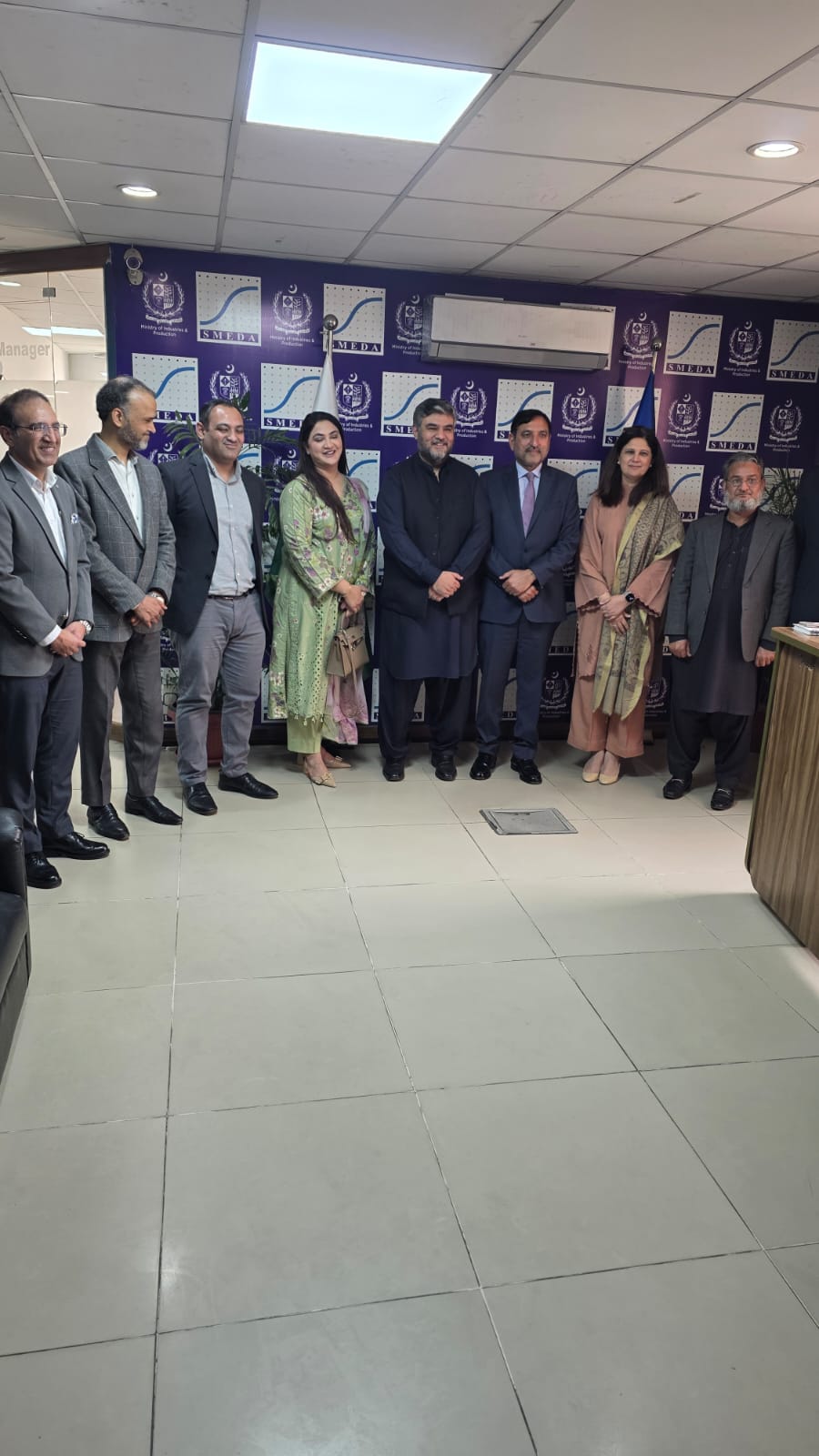
Lahore, February 17, 2026:
The Small and Medium Enterprises Development Authority (SMEDA) and the Trade Development Authority of Pakistan (TDAP) have resolved to advance an “Implementation Cooperation Framework Agreement” aimed at providing meaningful on-ground support to micro, small and medium enterprises (MSMEs) to help them scale up and become export-ready
The decision was taken, in line with the SME Development vision of the Prime Minister of Pakistan, during a meeting between representatives of the two organizations, led by CEO SMEDA Nadia Jahangir Seth and Chief Executive TDAP Faiz Ahmad, who decided to review the MoU previously signed between the institutions and agreed to move forward with a focused action plan.
Speaking on the occasion, CEO SMEDA Nadia Jahangir Seth stressed that the upcoming agreement would focus on achieving targeted milestones through a practical implementation strategy.
“The aim is to ensure tangible, on-ground support to MSMEs through training, improved access to finance and concrete measures to enhance Pakistan’s exports,” she said.
She said SMEDA is already executing a three-year Business Plan with renewed focus on cluster development. As part of these efforts, SMEDA recently engaged with SME clusters across the country – including light engineering, furniture and honey producers in Khyber Pakhtunkhwa – under the dynamic vision of Special Assistant to the Prime Minister on Industries and Production Haroon Akhtar Khan, she said.
The SMEDA chief also highlighted Prime Minister Shehbaz Sharif’s desire for meaningful collaboration between SMEDA and TDAP to accelerate initiatives supporting MSMEs and boosting national exports.
To streamline coordination, she nominated Mr Sheharyar Tahir, General Manager Gender & Sustainability, as focal person to liaise with TDAP and follow up on commitments. Director General TDAP Punjab Rafia Syed is the focal person for her organization.
Ms Seth thanked the TDAP delegation for visiting SMEDA and reaffirming commitment to serve as a partner in progress for Pakistan’s MSMEs by helping create an enabling ecosystem for growth and competitiveness. She lauded TDAP’s key role in export promotion initiatives.
Chief Executive TDAP Faiz Ahmad expressed enthusiasm about strengthening institutional collaboration to facilitate SMEs through practical and solution-oriented support. “It is time to deliver impactful support to entrepreneurs,” he said.
He stressed that the shared objective should be to transform aspiring enterprises into exporters and the goal is easily achievable in the age of e-commerce and digital technology.
He emphasized the importance of SMEDA identifying priority clusters and working jointly with TDAP to provide focused, comprehensive and results-driven support to enhance their capacity and contribution to national economic growth. He also called for regular coordination meetings and periodic reviews to ensure measurable outcomes.
Sharing his experience of travelling abroad, he said Pakistanis are among the most resilient people. “Despite challenges, our people perform remarkably well when given the opportunity. This potential must be tapped by creating a supportive business environment for SMEs,” he observed.
He appreciated SMEDA’s continued efforts for MSME development and expressed confidence that coordinated actions between the two organizations would yield meaningful results for entrepreneurs.
Meanwhile, Director General TDAP Punjab Rafia Syed underscored the importance of closer collaboration between SMEDA and TDAP to strength.
She also commended SMEDA for organizing Pakistan’s first “Made in Pakistan – SME Cluster Showcase Expo 2026,” describing it as a significant initiative that provided MSME clusters with valuable visibility and opportunities to develop business linkages. She said the TDAP looks forward to partnering with SMEDA for next year’s edition of the expo to make it an even more impactful platform for promoting Pakistani MSMEs.
The two organizations agreed to enhance cooperation and support the MSMEs after identifying priority areas to achieve the national economic objectives.#
Liaqat Ali Gohar (Media Consultant)
