
Pakistan and the Region: ISSI Conference Calls for Regional Cooperation Amid Emerging Threats
International speakers stress people-centric engagement, collective security, and urgent climate action

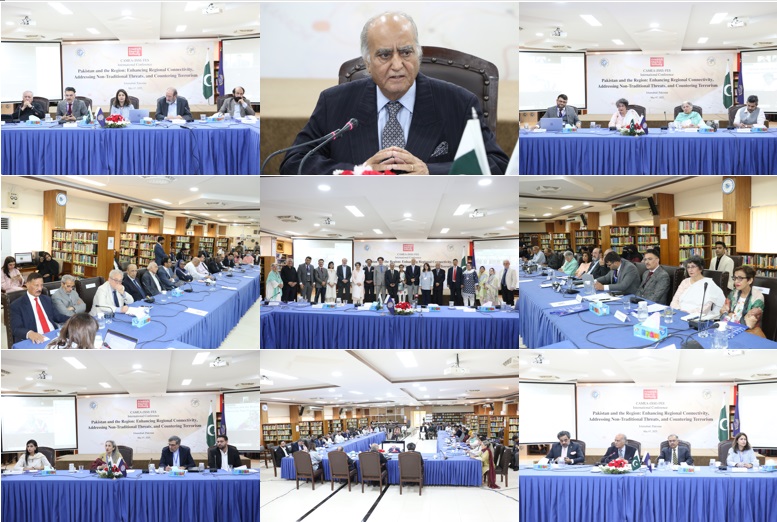
Pakistan and the Region: ISSI Conference Calls for Regional Cooperation Amid Emerging Threats
Experts emphasize connectivity, collective security, and urgent climate action at international forum in Islamabad
PRESS RELEASE
Islamabad, 8 May 2025 — The Centre for Afghanistan, Middle East and Africa (CAMEA) at the Institute of Strategic Studies Islamabad (ISSI), in collaboration with the Friedrich Ebert Stiftung (FES), Pakistan office, hosted a one-day international conference titled “Pakistan and the Region: Enhancing Regional Connectivity, Addressing Non-Traditional Threats, and Countering Terrorism.” Senator Mushahid Hussain Sayed graced the inaugural session as Chief Guest.
The conference comprised three thematic working sessions featuring regional experts, diplomats, academics, and practitioners, who deliberated on the evolving geopolitical and security landscape in South and Central Asia.
Session I: Pakistan-Afghanistan Relations – Challenges and Opportunities
Moderated by Ms. Amina Khan, Director CAMEA, this session brought together Ambassador Qazi Humayun (former Ambassador to Afghanistan), Mr. Hameed Hakimi (Afghanistan Research and Policy Initiative, Doha), Ambassador Ayaz Wazir, Mr. Zalmai Nishat (Mosaic Foundation, UK), journalist Mr. Tahir Khan, and Mr. Muzammil Shinwari (former Afghan Minister).
Discussions centered on the TTP threat, cross-border terrorism, the Taliban’s posture, India’s involvement, and refugee repatriation. Speakers emphasized pragmatic, people-centric diplomacy, soft power, and strengthening people-to-people ties. Proposals included formal engagement with the Taliban, inclusive governance in Afghanistan, and economic cooperation through regional initiatives like TAPI and CASA-1000.
Session II: Regional Security and Countering Terrorism – Evolving Threats and Response Strategies
Former Ambassador Seema Illahi Baloch moderated the second session, featuring Dr. Rustum Azizi (Tahlil, Tajikistan), Dr. Foad Izadi (University of Tehran), Ambassador Riffat Masood, Dr. Murat Aslan (Hasan Kalyoncu University, Turkiye), and Mr. Zeeshan Salahuddin (Tabadlab).
Speakers highlighted the growing risks posed by groups like ISIS-K and the fragmentation of militant networks. They stressed the need to reassess outdated threat perceptions and foster regional trust to address transnational challenges such as terrorism, water insecurity, and public disillusionment. The call for regional security architecture rooted in mutual respect and long-term collaboration was a recurring theme.
Session III: Addressing Non-Traditional Security Threats – Climate Change and Humanitarian Challenges
Chaired by Dr. Salma Malik (Associate Professor, Quaid-i-Azam University), this session included Mr. Ye Hailin (Chinese Academy of Social Sciences), Ambassador Mohammad Javad Shariati (IPIS, Tehran), Mr. Oves Anwar (RSIL), Dr. Darya Saprinskaya (Lomonosov Moscow State University), and Ms. Zile Huma (Deputy Secretary, Governor House, Pakistan).
Speakers warned of the humanitarian and economic fallout from climate-related threats such as floods, smog, and GLOFs, noting their link to food insecurity, migration, and regional instability. They advocated for green partnerships, regional coordination, and global adherence to international law. The discussion also addressed digitalisation, radicalisation, and the need for inclusive education and socio-political resilience.
Concluding Remarks
In his vote of thanks, Ambassador Khalid Mahmood, Chairman ISSI, underscored the importance of sustained dialogue on regional challenges, especially non-traditional threats. He noted the urgency of reaffirming international legal norms, particularly in light of ongoing violations of Pakistan’s sovereignty by India.
The conference was attended by a diverse audience, including foreign policy experts, academics, members of the media, think-tank professionals, and university students, fostering a rich exchange of ideas on critical regional issues.
Independent Desk
