

Independent Report
Quetta, October 12:
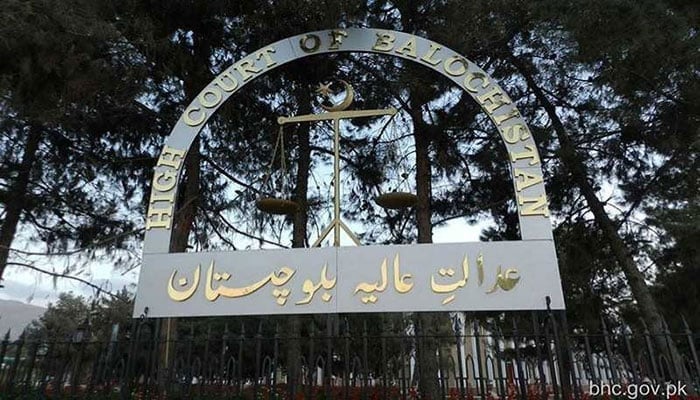
In a landmark judgment, the Balochistan High Court has ruled that prisoners convicted under the Anti-Terrorism Act (ATA) 1997 are not entitled to any form of special or general pardon.
A two-member bench comprising Justice Muhammad Kamran Khan Mulakhail and Justice Najamuddin Mengal dismissed all constitutional petitions filed during 2023 and 2024, clarifying that Section 21-F of the ATA excludes convicted terrorists from any legal leniency.
The court stated that the addition of Section 21-F in 2001 was a deliberate legislative act aimed at permanently excluding terrorism convicts from the scope of pardon or remission. The bench further ruled that the ATA, being a special law, prevails over general laws, including the Prisons Act of 1894.
Rejecting the petitioners’ argument that the denial of pardon violates Article 25 (equality before law) of the Constitution, the court held that terrorism convicts form a distinct legal class and that such classification is constitutionally valid.
Referring to landmark Supreme Court judgments — including Sherwani Case, Government of Balochistan vs. Azizullah, and Dr. Mubashir Hassan vs. Federation of Pakistan — the court reiterated that reasonable classification based on lawful grounds does not constitute discrimination.
The High Court directed the Home Department, Inspector General (IG) Prisons, and relevant superintendents to immediately withdraw all illegal pardons and reassess the sentences of affected inmates. The judgment also instructed that no future remission be granted without strict adherence to legal procedures, warning that violations may result in disciplinary action.
The bench ordered certified copies of the verdict to be dispatched to the Secretaries of Home, Law, and Tribal Affairs departments, the Advocate General, Prosecutor General, and IG Prisons for immediate compliance.
Additionally, the court directed that all convicts — including those serving life or short-term sentences — must serve at least two-thirds of their punishment under Rule 217 of the Pakistan Prison Rules 1978, unless granted extraordinary remission under law.
The bench expressed concern over excessive and arbitrary pardons, noting cases where convicts like Sona Khan and Amanullah received remission exceeding their actual sentence served. Such acts, the court remarked, violate the principles of justice and the rule of law.
