
Pakistan’s First Astronaut to Conduct Four Scientific Experiments Aboard China’s Tiangong Space Station

Independent report
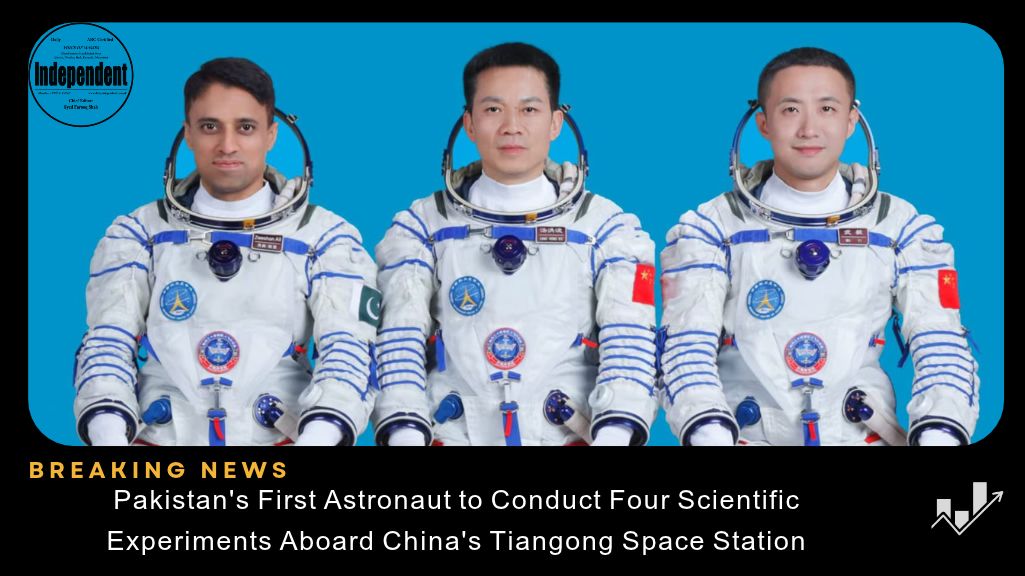
RAWALPINDI: Pakistan’s first astronaut mission has entered its final stages, with Muhammad Zeeshan Ali set to travel to China’s Tiangong Space Station under a historic human spaceflight mission led by the China Manned Space Agency (CMSA) in partnership with Pakistan’s Space and Upper Atmosphere Research Commission (SUPARCO).
As a Payload Expert, Zeeshan Ali will be responsible for carrying out Pakistan’s scientific research programme aboard the space station, conducting experiments in microgravity in collaboration with Chinese research institutions and universities.


The four experiments, developed by Pakistani researchers, cover materials science, fluid physics, life and biological sciences, and biotechnology. They are aimed at exploring potential applications in climate resilience, food security and industrial innovation.
One of the experiments will involve establishing green micro-factories to support sustainable life in space. It will examine the cultivation of microalgae as a potential source of nutrients and oxygen for future long-duration space missions.
The remaining three experiments will be deployed on external experimental modules of the Chinese Space Station, where they will remain exposed to the space environment for one year.
These experiments include studying the effects of microgravity and cosmic radiation on the longevity of quinoa seeds during spaceflight, with the objective of developing more resilient and radiation-tolerant crop varieties.
Another experiment will examine the healing efficiency of microcapsule-based self-healing composite materials in space environments, potentially reducing maintenance requirements in aircraft, spacecraft and infrastructure.
The fourth experiment will evaluate the performance and durability of hybrid composite materials exposed to the vacuum, radiation and extreme temperatures of outer space, with a view to improving spacecraft protection.
The scientific programme is being conducted with Chinese support in collaboration with the Centre for Space Utilization, Shanghai Institute of Technical Physics, Dalian Maritime University and Shanghai Jiao Tong University.
The mission marks a significant milestone in Pakistan’s space exploration history and reflects the growing scientific and technological cooperation between Pakistan and China.
