
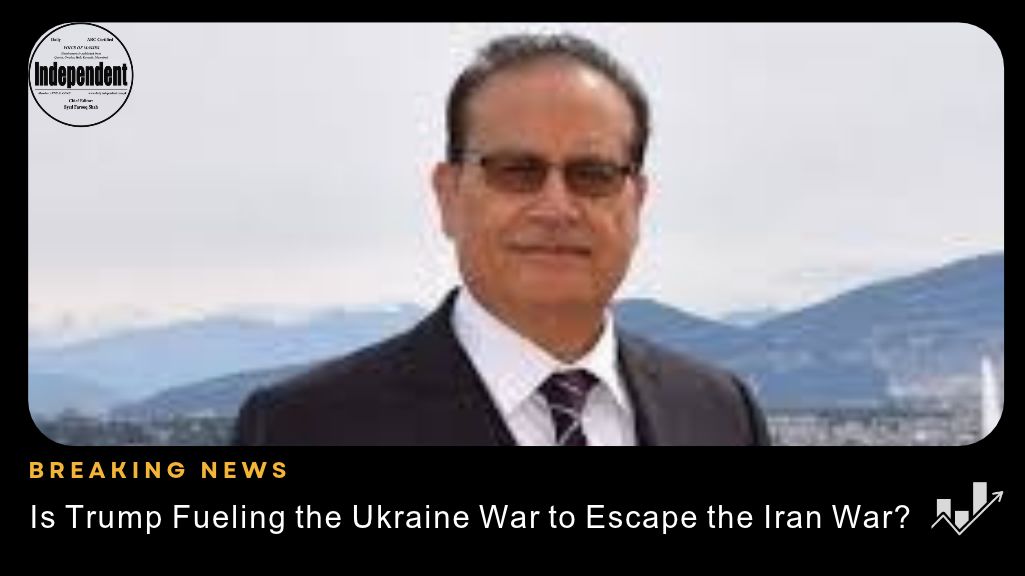
Qamar Bashir
Press Secretary to the President (Rtd)
Former Press Minister, Embassy of Pakistan to France
Former Press Attaché to Malaysia
Former MD, SRBC | Michigan, USA
As if he were the king of the entire world, President Donald Trump has now suggested that the time has come for Ukraine to replace President Volodymyr Zelensky. This extraordinary assertion exposes the hubris of a president whose country has historically championed democracy, constitutional governance, national sovereignty and the fundamental right of people to choose their leaders. Zelensky was elected by the Ukrainian people, and it is exclusively their prerogative to decide whether their country requires a change of leadership, not that of the American president.
Trump’s frustration apparently stems from Zelensky’s refusal to bow to Washington’s dictates and accept a settlement that Kyiv considers incompatible with its national interests. Instead of respecting Ukraine’s sovereign right to determine its future, Trump appears to regard resistance to American demands as sufficient justification for advocating a leadership change. Such an attitude undermines the very democratic principles upon which America has traditionally based its international standing.
Equally disturbing is Trump’s reliance on Steve Witkoff and Jared Kushner to navigate some of the most consequential geopolitical crises confronting humanity. Both come primarily from business backgrounds rather than the traditional diplomatic establishment. Their involvement in negotiations concerning Ukraine and Iran raises serious questions about the administration’s diplomatic judgment, institutional capacity and selection of negotiators.
Their inability thus far to secure durable settlements in either conflict reflects the inadequacy of an approach that treats complex geopolitical disputes as commercial transactions. Instead of narrowing differences, American diplomacy appears increasingly incapable of reconciling competing positions. The parties remain deeply divided, while military escalation threatens to render diplomatic initiatives increasingly irrelevant.
Trump returned to power promising to end the Ukraine war rapidly. Nearly two years into his presidency, however, peace remains elusive. His suggestion that Ukraine requires a new president appears to be an attempt to transfer responsibility for his diplomatic failures onto Zelensky, rather than acknowledge the inadequacies of his own negotiating strategy.
Nothing exposes Trump’s narrow strategic outlook more clearly than his public objection to Ukrainian attacks on Russian oil refineries. Trump repeatedly emphasized that he had instructed Zelensky not to attack refineries because of the potential consequences for American farmers, ranchers and the broader economy.
While European leaders regard Russian military expansion as an existential security challenge, the American president appears preoccupied with maintaining affordable fuel supplies for domestic consumers. The contrast is extraordinary. An international crisis involving territorial sovereignty, European security, nuclear powers and the future of NATO is being viewed through the prism of American diesel prices.
Protecting domestic economic interests is a legitimate responsibility of any president. However, reducing a geopolitical crisis of this magnitude to immediate commercial considerations exposes the poverty of strategic thinking within the administration. American diplomacy should be addressing the legitimate security concerns of Ukraine, Russia and Europe through a comprehensive negotiating framework.
Instead, the conflict is expanding geographically and intensifying militarily. The Black Sea has become an increasingly contested theatre, while attacks on Russian energy infrastructure and the Crimean Bridge have further aggravated tensions. Reports of attacks against Russian maritime interests beyond the immediate conflict zone suggest that the geographical boundaries of the confrontation could expand further.
The Institute for the Study of War’s November 20 assessment reported that Russia launched 515 missiles and drones against Ukraine, targeting energy, transportation and industrial infrastructure. Russian projectiles also reportedly entered Polish airspace, prompting NATO military responses and Polish requests for additional air defence capabilities.
Meanwhile, the British- and French-led multinational component of the 37-nation Coalition of the Willing conducted military exercises in Poland involving approximately 5,000 to 6,000 personnel. These developments demonstrate how dangerously close the conflict is moving towards a broader confrontation between Russia and Europe.
The diplomatic contradictions are equally alarming. American negotiators have reportedly explored Ukrainian territorial concessions in exchange for NATO membership or alternative international security guarantees. Moscow, however, continues to reject Ukrainian NATO membership and demands neutrality, restrictions on Western military assistance and a broader restructuring of European security.
Zelensky has described Russia’s proposed European security architecture as dangerous, warning against a second Yalta agreement that could divide Europe into spheres of influence. European leaders, meanwhile, have reaffirmed their commitment to Ukraine, insisting that no settlement concerning Europe can be negotiated without European participation.
One European leader went so far as to compare Zelensky’s contribution to European freedom and dignity with that of Winston Churchill, promising continued support for as long as necessary. The contrast with Trump’s demand for Zelensky’s replacement could hardly be more striking.
There is also a potentially more calculated dimension to Washington’s conduct. The escalating Ukraine confrontation could divert international attention from America’s unresolved conflict with Iran. As European security increasingly dominates international headlines, Trump may find an opportunity to disengage from the Iranian theatre without having to confront the full political consequences of his administration’s failure to achieve its objectives.
Whether deliberate or incidental, such a diversion would offer Washington a face-saving opportunity. However, attempting to escape one geopolitical crisis while another escalates would hardly constitute a diplomatic achievement. It would merely substitute one strategic failure for another, potentially exposing the world to even greater instability.
The most consequential outcome of Trump’s presidency may ultimately be the fragmentation of America’s traditional alliances. Washington and Europe, which maintained a remarkably durable strategic partnership throughout the postwar era, increasingly find themselves pursuing divergent geopolitical objectives, operating under different strategic assumptions and moving in different directions.
This deterioration is not confined to Europe. America’s relations with Canada and Mexico have also experienced considerable strain. Even its historically close relationship with Israel has encountered differences over regional military objectives and American national interests. Washington’s diplomatic approach increasingly appears transactional, unpredictable and incapable of sustaining the confidence of longstanding partners.
The principal beneficiary of this fragmentation is likely to be China. Russia remains a formidable military and nuclear power, but China possesses the economic strength, technological capabilities, commercial reach and diplomatic resources necessary to challenge American global leadership comprehensively.
China’s diplomatic outreach, economic partnerships and cultivation of relationships across Asia, Africa, Latin America and the Middle East stand in sharp contrast to Washington’s increasingly confrontational engagement with both adversaries and traditional allies.
The widening division between America and Europe could provide Beijing with an unprecedented opportunity to elevate its diplomatic stature, expand its geopolitical influence and emerge as the principal beneficiary of Western disunity. American supremacy cannot be sustained indefinitely through military expenditure, economic coercion and presidential rhetoric while the diplomatic foundations of its global leadership are systematically eroded.
This should be an eye-opening moment for the American political establishment. With Democrats gaining renewed political leverage following the midterm elections, there is an urgent need for bipartisan understanding to arrest America’s growing isolation, restore confidence among its traditional allies and reestablish diplomacy as an instrument of strategic leadership.
America’s greatness was built not merely upon military and economic superiority but upon its ability to mobilize international partnerships, cultivate trust and provide leadership during global crises. Trump risks squandering that invaluable inheritance within a remarkably short period.
Time is of the essence. Unless America’s political leadership acts decisively to reverse the damage, Washington may discover that while its president behaves as though he rules the entire world, the world itself is increasingly learning to move forward without American leadership.

