

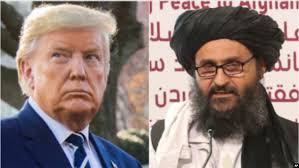
“Taliban – World Peace and Trump”
The Taliban government was established in Afghanistan when US policymakers began negotiations with Taliban fighters in Doha, Qatar, and kept the then Afghan democratic government out of the process. The negotiation process began during the first term of the Trump administration and ended during the Biden administration, raising many questions.
The Taliban waged war on various provinces and fronts to occupy Afghanistan and also gained control in Kabul after minor resistance. Afghan soldiers left their weapons and military posts and allowed the Taliban to come. Afghan President Ashraf Ghani left the throne of Kabul with tears in his eyes and left the country. The warplanes at Bagram Air Base went to a neighboring country and are still there, while most Afghan government officials at Bagram Airport boarded American planes and fled the country, and the situation there is a separate discussion.
The analyses and concerns of observers and analysts all came to naught when Ashraf Ghani and his other colleagues, with a stone in their hearts, decided to save the country from civil war and destruction and acted with intelligence and intelligence. And it is also a separate topic why such steps were taken.
However, the Taliban government was established throughout Afghanistan, on which some Pakistani policymakers at that time also expressed joy and happiness, the bad effects of which are still being felt on the Pakistani borders.
After the establishment of the Taliban government in Afghanistan, various malicious and terrorist incidents have been occurring in Pakistan, of which the responsibility for most of the attacks and incidents has been accepted by the banned Tehreek-e-Taliban Pakistan (TTP), despite the fact that Pakistani policymakers had accused the Ashraf Ghani government of being pro-India and had expected the Taliban to maintain brotherly relations with Pakistan.
The TTP, by uniting several small groups within Afghanistan, has intensified its operations in the Pashtun areas of Pakistan and has carried out several operations every day from Balochistan to Chitral, in which people as well as police and military personnel were targeted.
In the context of this entire situation, this warning by the Pakistani representative to the United Nations is definitely a moment of reflection for the international community, in which it is said that the TTP, the largest jihadist group operating in Afghanistan, may emerge as a branch of Al-Qaeda and pursue an agenda of destabilizing neighboring countries.
These words were made by Pakistan’s acting representative to the United Nations, Usman Jadoon, while addressing an important meeting of the United Nations Security Council. He said that the Pakistani border in Afghan territory is a safe haven for the banned TTP, which consists of about 6,000 fighters, from where several attempts have been made to infiltrate Pakistani areas and there have been several incidents of firing targeting Pakistani security personnel and their fronts.
According to the statement of the Pakistani delegate, while combating the operations of the banned TTP across the border, that is, in Pakistani areas, Pakistani security and border officials have seized some modern weapons that the Afghan interim government, the Taliban government, has obtained from the reserves left by foreign forces in Afghanistan.
It is also worth noting here that there is no data on what kind of weapons and ammunition the foreign forces left behind while leaving Afghan soil and how many of them they had, while on the other hand, some modern weapons reserves were also with the forces of the Ashraf Ghani government. No one has authentic information about what kind of weapons they were and how many were there.
What kind of deadly weapons have the former Afghan army and foreign forces left behind while leaving Afghan soil and which jihadi groups have they fallen into the hands of.
The Pakistani delegate, while addressing the Security Council meeting, said that the banned TTP, as an offshoot of Al-Qaeda, is playing an effective umbrella role for other jihadist groups and that these mischievous groups have been receiving financial support from Pakistan’s enemy India, which is a matter of concern. There is an urgent need to realize the potential threat of terrorism posed by the banned TTP to Pakistan and other countries in the region. Before terrorists get a new opportunity to destroy world peace, the world nations should adopt a common strategy in this regard.
This fear of the Pakistani delegate is pointing to another possible Great Game in the region for world peace, including Pakistan, because on the other hand, Donald Trump has become the powerful president of a superpower like America by entering the White House for the second time. During the election campaign and while taking the presidential oath, he has clearly said that America has to be made greater than ever and the series of wars around the world has to end and establishing peace is among the priorities. But here, some unpleasant incident is happening every day on the Pak-Afghan border and the Pakistani government and security agencies always accuse the Taliban government that these fighters, after getting trained in Afghanistan, carry out terrorist acts in Balochistan and especially Pakhtunkhwa with planning and return to their safe havens, which are located on the Afghan borders.
The Pakistani army has entered Afghanistan two or three times and issued statements targeting the outlawed TTP camps, to which the Taliban government has expressed its disapproval of these attacks every time.
Looking at this entire situation, what steps will the Trump administration take regarding this and what policy will it adopt regarding Afghanistan and the Taliban? Or are American interests still intact in this region, for which a mysterious and economically minded figure like Trump will formulate a policy, as China’s influence in the region continues to grow?
( Hairan Momand)
