

Islamabad, November 12:
Independent report
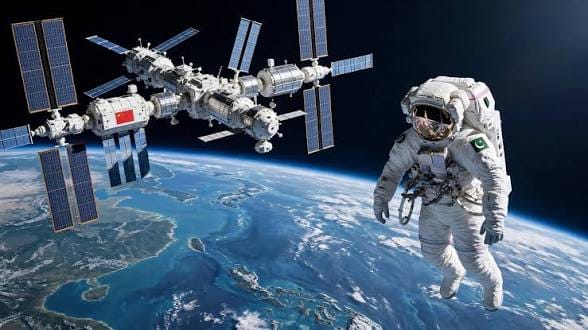
Pakistan’s efforts to strengthen its space capabilities are set to enter a new phase as a Pakistani astronaut prepares to participate in a Chinese crewed space mission, marking a significant milestone in bilateral space cooperation.
According to a report by China Economic Net, the Pakistani astronaut will participate in China’s Shenzhou-24 mission as a payload specialist, becoming the first foreign astronaut to visit China’s space station.
The astronaut will undertake a short-term orbital flight and return to Earth aboard the Shenzhou-23 spacecraft, according to China’s Manned Space Agency.
For Pakistan, the mission represents more than a symbolic achievement. It will provide an opportunity to gain practical experience in human spaceflight, scientific payload operations and astronaut training, potentially contributing to the country’s long-term space ambitions.
Zhang Chaozhe, Director of the Pakistan Study Center at Sichuan University, said participation in China’s space mission would give Pakistan access to training, research and operational experience that would be difficult to develop independently.
The mission also marks a new phase in China-Pakistan space cooperation, which has continued for more than three decades.
In 1990, Pakistan’s first experimental satellite, Badr-1, was launched aboard a Chinese rocket from the Xichang Satellite Launch Center. More recently, Pakistan’s PRSC-EO3 remote-sensing satellite was successfully placed into orbit by a Chinese Long March-6 rocket in April 2026.
Zhang said China-Pakistan space cooperation had gradually expanded from satellite launches and related projects to more advanced areas, adding that the participation of a Pakistani astronaut in a Chinese crewed mission reflected growing bilateral trust and technological cooperation.
He noted that human spaceflight required close coordination in astronaut safety, technical systems and mission operations, making mutual confidence essential.
The mission also highlights opportunities for developing countries through China’s space station programme.
In cooperation with the United Nations Office for Outer Space Affairs (UNOOSA), China has opened its space station to international scientific experiments. The first round of cooperation selected nine projects involving 23 institutions from 17 UN member states.
For countries with developing space programmes, such initiatives provide an opportunity to participate in space research without independently establishing the extensive launch and orbital infrastructure required.
Zhang emphasised that space exploration should not remain limited to a small number of countries with established space programmes, adding that international cooperation could help developing nations participate in scientific research, gain experience and gradually strengthen their capabilities.
The Pakistani astronaut’s mission is therefore significant both for advancing the longstanding partnership between Pakistan and China and for opening new avenues for Pakistan’s participation in human spaceflight and scientific research.
