

Independent report
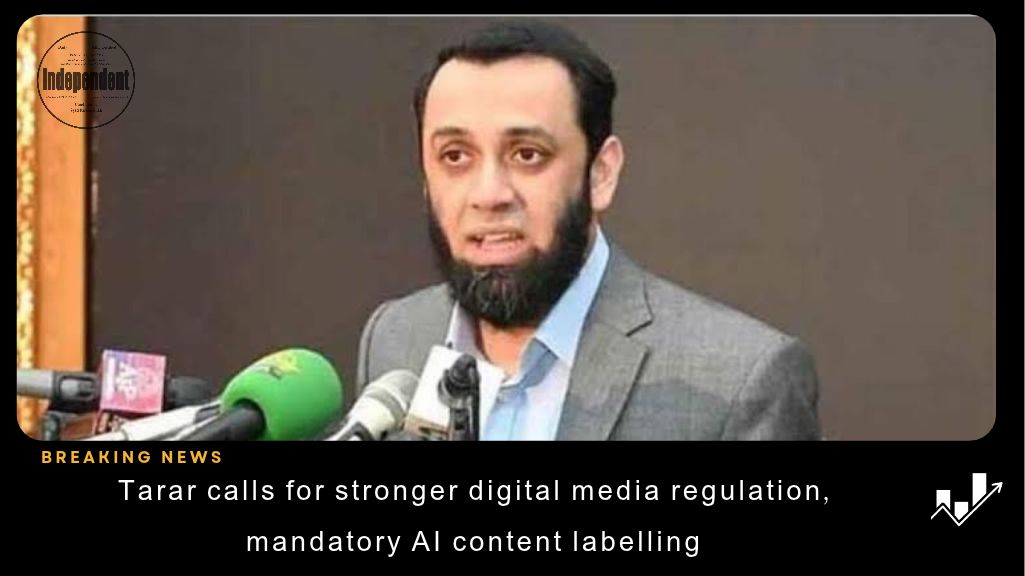
ISLAMABAD, November 5: Federal Minister for Information and Broadcasting Attaullah Tarar has called for a comprehensive regulatory and legal framework for social media platforms, mandatory labelling of artificial intelligence-generated content and greater public awareness to counter misinformation and disinformation.
Addressing the 29th Sustainable Development Conference, organised by the Sustainable Development Policy Institute (SDPI) at Allama Iqbal Open University, the minister said fake and unverified information had become a major challenge requiring coordinated efforts by the government, media organisations, social media platforms and civil society.
Speaking on the theme “Rethinking Development in the Post-truth Era”, he emphasised that verification of information was more important than its speed of dissemination.
Referring to Marka-e-Haq, Tarar said Pakistan had demonstrated national unity and responsible media engagement, with journalists, young people and social media users playing an important role in countering misinformation.
He said Pakistan had responded to false and fabricated claims circulated by India before, during and after the conflict by presenting verified information supported by evidence and credible sources.
The minister particularly appreciated the role of young Pakistanis, saying Generation Z had demonstrated strong digital media skills in identifying and exposing misleading information.
He said electronic media had established editorial and regulatory mechanisms, while social media required a stronger framework to address misinformation, disinformation and digitally fabricated content.
Tarar called for improved coordination with social media platforms, stronger fact-checking mechanisms and mandatory AI labelling. He cited TikTok’s AI-content labelling system and X’s Community Notes feature as examples of initiatives aimed at helping users identify misleading or outdated material.
He also stressed the need for specialised training and capacity-building for journalists, media professionals and students of mass communication and digital media.
The minister said the Ministry of Information and Broadcasting had established Pakistan’s first Digital Communication Department by amending its rules of business. The department brings together specialists in graphic design, video editing, content creation and scriptwriting to ensure the delivery of verified information through appropriate digital platforms.
Discussing crisis communication, he said information should be released in a timely, coordinated and gradual manner to prevent unnecessary panic while keeping the public informed.
On cybercrime, Tarar said the National Cyber Crime Investigation Agency (NCCIA) had been established to address offences committed in the digital space, with regional offices being set up and personnel receiving specialised training.
He said the Prevention of Electronic Crimes Act (PECA) provided the legal framework for dealing with cyber offences, including online harassment, blackmail, threats and child abuse-related crimes.
He emphasised the need to raise public awareness, particularly among women and marginalised groups, about complaint mechanisms and legal remedies against online harassment and exploitation.
The minister also called for psychological support and counselling facilities for victims of online blackmail and the misuse of private images, stressing that perpetrators must be brought to justice.
Proposing an international convention backed by a global organisation, Tarar said collective efforts were needed to address the harmful use of artificial intelligence and curb misinformation, disinformation and fabricated content.
He warned that the misuse of AI was also affecting creative industries and threatening the livelihoods of professionals associated with advertising, filmmaking, modelling and content production.
Clarifying the scope of PECA, he said the law was intended to prevent electronic crimes and was not aimed at restricting freedom of expression or obstructing journalists from performing their professional duties.
He said freedom of expression was a constitutional right that must be exercised responsibly and could not be used to threaten or harm others.
The minister added that regulatory institutions, including the Pakistan Electronic Media Regulatory Authority (PEMRA), dealt with matters falling within their respective jurisdictions, while PECA addressed offences committed in cyberspace. He stressed that the same offence should not result in double jeopardy.
Tarar also called for stronger enforcement, effective prosecution and public awareness to make digital spaces safer, particularly for women and vulnerable sections of society.
