
Independent report
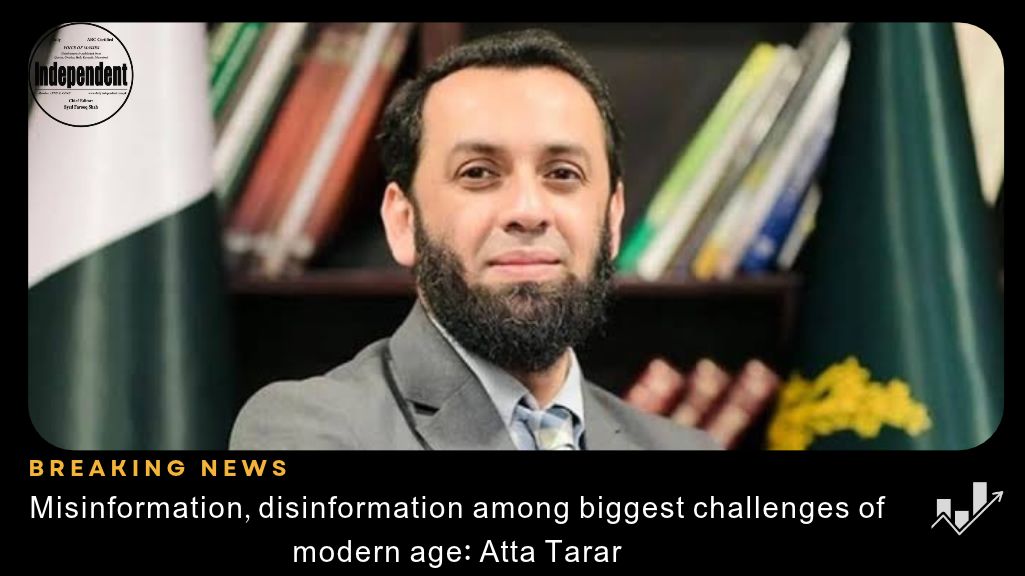
ISLAMABAD, Nov 25: Federal Minister for Information and Broadcasting Attaullah Tarar on Wednesday said misinformation and disinformation were among the biggest challenges of the modern age, as the definition of a broadcaster continued to evolve rapidly.
Speaking as a panellist at an international conference on Social Media Platforms and the Post-Truth Era, organised by the Sustainable Development Policy Institute (SDPI), the minister highlighted the changing social media landscape in Pakistan, where nearly 100 million people use social media and around 160 million use smartphones.
Responding to a question about false narratives, he said that when something went viral, it took only minutes to spread widely. Before declaring a news item false, he said, it was essential to examine its source and determine whether it was authentic.
He said that traditionally, broadcasters included radio, television and other forms of media, but the definition had changed with the emergence of social media. Today, anyone with a smartphone could act as a broadcaster.
With such a broad definition of a broadcaster, he added, verifying information had become increasingly difficult.
Referring to a World Economic Forum report, the minister said misinformation and disinformation were among the greatest threats of the modern age. With millions of sources of information emerging, declaring something fake or false had become a significant challenge.
He referred to negotiations with a religious party that was subsequently banned, saying that during the talks the party had demanded the closure of certain multinational companies. However, when asked why it had not called for the closure of social media platforms, which were also owned by foreign entities, the party had opposed such a move, saying the platforms were essential for promoting its ideology and agenda.
The minister said the threat had gone far beyond simply identifying a false narrative.
He said the online environment was financially incentivising terrorism, harassment and child abuse, as content that went viral could generate direct financial rewards.
He called for addressing algorithmic injustice that allowed content creators to earn money based on the popularity and views of their material, regardless of its harmful nature.
Attaullah Tarar said a video recently released by the Balochistan Liberation Army (BLA) had been brought to the attention of certain social media platforms. He said the government had pointed out that the organisation was involved in terrorism and killing innocent people, and had requested the removal of the content, but it had not been taken down.
He said the debate had therefore moved beyond the issue of identifying false information and now involved the broader challenges of terrorism, harassment of women and protection of citizens’ dignity and privacy.
The minister appreciated the compliance of certain social media platforms, particularly those that labelled AI-generated videos, enabling viewers to identify content created through artificial intelligence.
He welcomed the opening of social media platforms in Pakistan and wished them success in their businesses, saying the country’s vibrant youth and their ability to create positive content offered considerable potential.
He said the government wanted to work closely with social media platforms to counter these challenges.
The minister also highlighted the government’s engagement with various platforms over the years, noting that compatibility between their policies and local legislation remained an issue.
He said Pakistani laws were applicable within the country’s jurisdiction and that social media platforms needed to align their policies with local legal requirements.
Attaullah Tarar said every country had its own dynamics and challenges, and a uniform policy could not be effective everywhere.
He called for the issuance of an Islamabad Declaration from the conference to engage social media platforms in establishing a working group aimed at ensuring cohesive and mutually supportive regulations.
The minister also proposed the formation of a national task force with representation from all stakeholders, including federal and provincial governments, relevant institutions and ministries.
He said social media platforms did not have an inherent system to filter such content at the initial stage, making it necessary to repeatedly bring to their attention posts originating from terrorist organisations that required removal.

