

Independent report
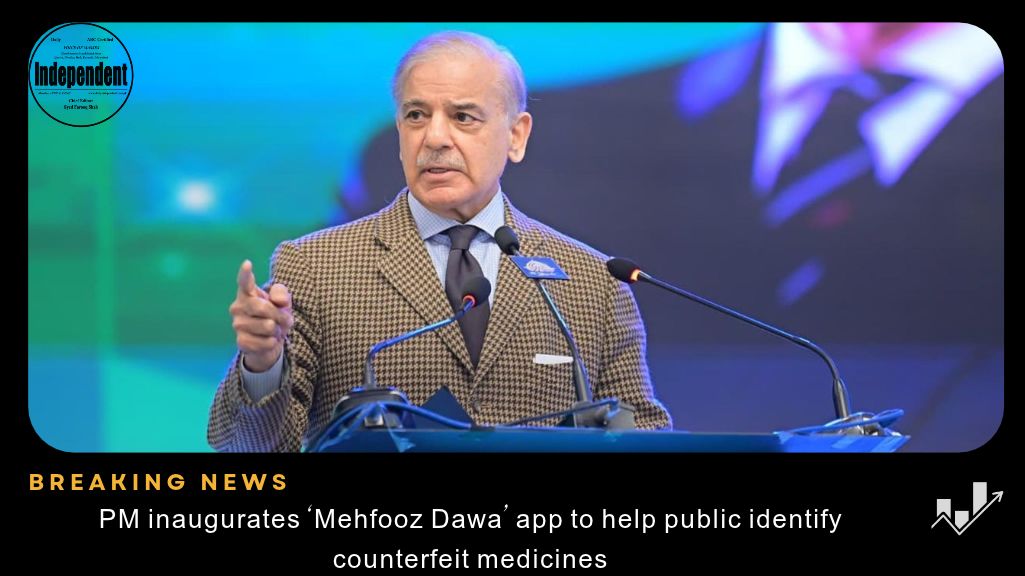
ISLAMABAD, Nov 26: Prime Minister Shehbaz Sharif on Thursday inaugurated the Mehfooz Dawa mobile application, a digital initiative aimed at enabling citizens to verify the authenticity of medicines and protect themselves against counterfeit and substandard drugs.
The prime minister inaugurated the application by scanning the barcode printed on a medicine packet, which displayed a green signal confirming the medicine’s authenticity.
Addressing the inauguration ceremony, he described the initiative as an important step towards improving healthcare facilities and ensuring the provision of safe medicines to the public.
Recalling a tragic incident during his tenure as chief minister of Punjab in 2010-2011, he said reports had emerged about the deaths of around 100 patients undergoing treatment at the Punjab Institute of Cardiology following the use of a particular medicine.
He said he had immediately collected samples of the suspected medicines and sent them to laboratories in London, Geneva and Paris for independent verification.
According to the prime minister, the results received from the laboratories revealed that the medicines in question were intended for the treatment of malaria rather than heart diseases, and had consequently been administered to cardiac patients at the hospital.
He said the incident underscored the importance of strengthening regulatory oversight and introducing modern technological solutions to prevent similar tragedies.
The prime minister described the Mehfooz Dawa application as a significant initiative to facilitate the public and address shortcomings in the healthcare system.
He congratulated the team involved in developing the application and appreciated the contributions of Minister for National Health Services Syed Mustafa Kamal, the minister for information technology, the ministry’s secretary, the Digital Authority, SIFC, pharmaceutical industry representatives and relevant departments.
Highlighting inequalities in access to healthcare, he said privileged citizens could afford treatment at leading hospitals, while millions of ordinary people struggled to meet even their basic food requirements, making medical treatment an additional financial burden.
He assured that the government remained committed to providing health and education facilities to every citizen.
The prime minister expressed hope that further initiatives would be introduced, with the cooperation of pharmaceutical industry owners and other stakeholders, to provide maximum relief and convenience to the public.
Drawing a comparison with the government’s fuel subsidy mechanism, he said the Mehfooz Dawa application would make medicine verification simple and accessible, just as the subsidy process had been streamlined.
Speaking on the occasion, Minister for National Health Services Syed Mustafa Kamal said the initiative could help save precious human lives by empowering people to distinguish genuine medicines from counterfeit products.
He said around 700 pharmaceutical companies had shared data relating to approximately 92,000 medicines, enabling the application to verify their authenticity.
With nearly 200 million mobile phones in the country, the minister said the application had the potential to reach people across Pakistan.
He added that the system had been designed to be user-friendly, allowing even people with limited literacy to identify suspicious medicines through simple colour indicators. A green signal would indicate a genuine medicine, while a red signal would alert users to a potentially counterfeit product.
Chief Executive Officer of the Drug Regulatory Authority of Pakistan (DRAP) Dr Ubaidullah said the government had issued clear directions for the complete digitisation of the authority’s regulatory system as part of broader institutional reforms.
He said all regulatory processes of DRAP had now been digitised end-to-end.
Explaining the application’s features, he said citizens could scan medicine barcodes to verify authenticity, check registered prices and confirm expiry dates.
The application also provided a facility for citizens to lodge complaints against suspected medicines, which would be addressed through a comprehensive regulatory enforcement mechanism.
The system would also be supported by an integrated Rapid Alert System to facilitate the timely identification, reporting and response to potential risks involving medicines.
