

Independent report
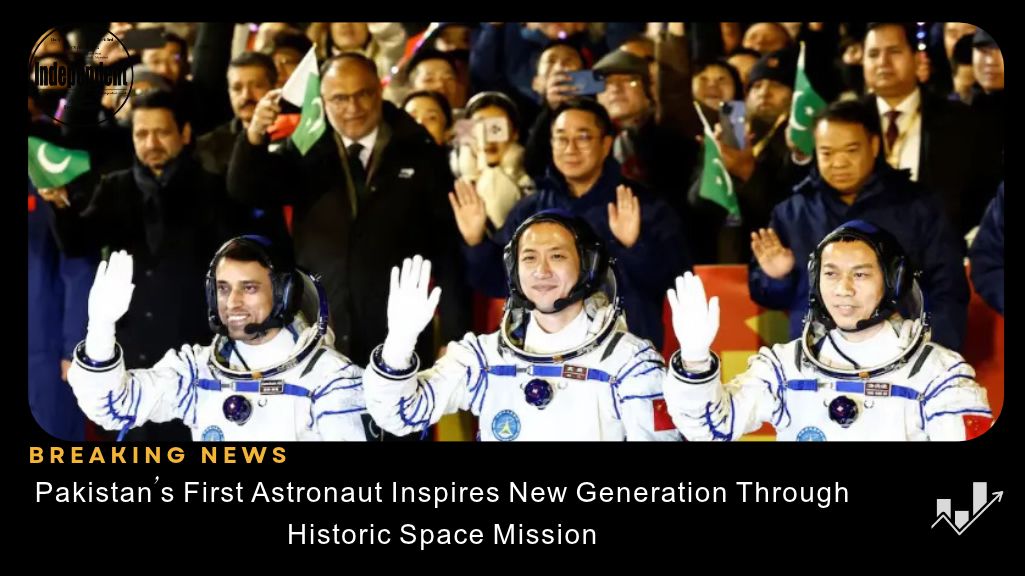
ISLAMABAD, November 29, 2026: For millions of young Pakistanis, Muhammad Zeeshan Ali’s journey aboard China’s Tiangong space station represents more than a milestone in space exploration. It offers a glimpse of what their own futures could hold.
As the first Pakistani to reach orbit and the first foreign astronaut to visit China’s space station, Ali carried his country’s flag into space, along with the hopes and aspirations of a generation.
“It was not the person of Zeeshan Ali, it was the country Pakistan that was also flying with him,” Planning Minister Ahsan Iqbal said, according to a report carried by China Economic Net (CEN) on Sunday.
Iqbal made the remarks after witnessing the launch of the Shenzhou-24 mission.
For the minister, the significance of the mission extends far beyond the historic flight. Its greatest impact, he believes, may lie in inspiring young Pakistanis to pursue space science, scientific exploration and STEM education.
The milestone marks the latest chapter in a space partnership that has been decades in the making.
Pakistan established its national space agency, the Space and Upper Atmosphere Research Commission (SUPARCO), in 1961, making it one of the earliest space agencies in Asia.
Cooperation with China has since expanded from satellite technology to broader space research. Chinese launch services have supported Pakistani satellite missions, including the PAKSAT-1R communications satellite in 2011 and the PRSS-1 remote-sensing satellite in 2018.
Iqbal said the ambition to take this partnership into human spaceflight dated back to discussions with Chinese counterparts in 2017 and 2018, when the two countries were advancing cooperation in infrastructure, communications and other fields.
The vision moved closer to reality in February 2025, when SUPARCO and the China Manned Space Agency signed an agreement for Pakistan’s first astronaut mission to the Chinese space station.
Two Pakistani candidates, Muhammad Zeeshan Ali and Khurram Daud, completed training in China, with Ali selected for the flight.
The preparation involved technical and physical training, learning Chinese and building close working relationships with Chinese counterparts.
Iqbal also praised the care extended to the Pakistani astronauts, including the provision of halal meals during their stay.
The mission, he told China Economic Net, has opened a new avenue for cooperation and demonstrated how the two countries can turn long-standing ambitions into concrete results.
For Pakistan’s younger generation, however, its most lasting legacy may still lie ahead.
Iqbal envisaged classrooms where teachers ask students whether they watched the launch and what it means to explore space. Such questions, he said, could spark curiosity and inspire future generations of scientists, satellite engineers and astronauts.
Pakistan’s Ambassador to China, Dr Syed Ali Asad Gillani, echoed that view, describing Ali as a potential “icon” and “role model” for young people. He plans to arrange for the astronaut to meet students at the Pakistani embassy school after completing his mission.
The two countries are also looking beyond the space station. Pakistan hopes to send a lunar rover on a future Chinese lunar mission and aims to develop its own capability for a lunar landing by 2035.
Gillani has also proposed training at least 10,000 Pakistani PhD graduates at leading Chinese universities over the next decade in fields including space science, artificial intelligence and materials science.
One astronaut’s journey cannot transform a country’s scientific capabilities overnight. But it can change what a generation believes is possible.
Today, millions of young Pakistanis can look up at the sky and see one of their own among the stars. Tomorrow, some of them may help take their country’s space ambitions even further.
