
PM calls for national dialogue, structural reforms and youth empowerment to accelerate economic growth

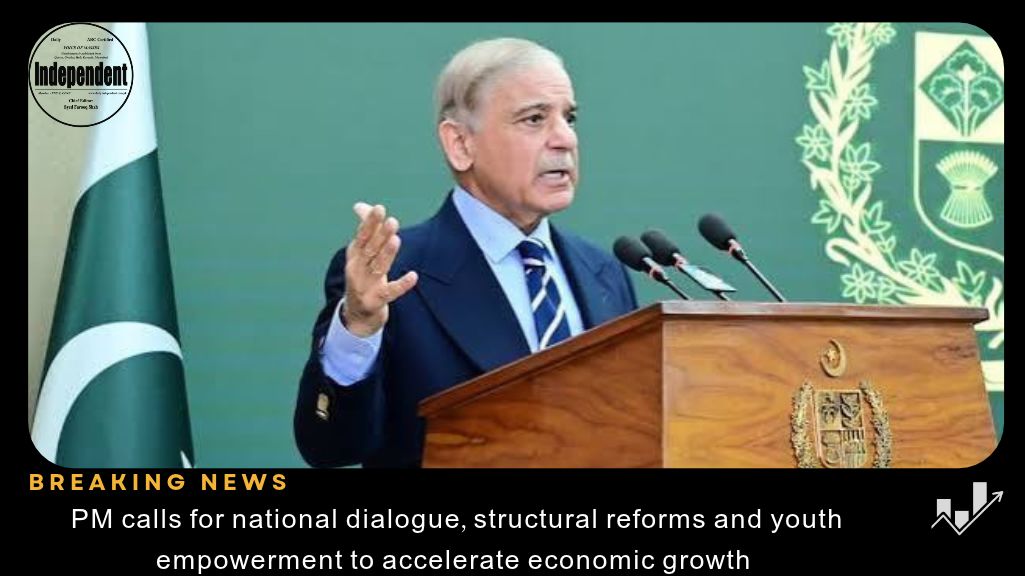
ISLAMABAD, November 29: Prime Minister Muhammad Shehbaz Sharif has stressed the need for national dialogue, political harmony and stronger federal-provincial coordination to accelerate Pakistan’s socio-economic development, saying the country’s economic growth must rise from the projected 3.5 percent to at least six percent at the earliest.
Addressing participants of the National Security Workshop on Sunday, the prime minister said the government had inherited serious economic challenges but had made progress towards stabilization through difficult policy decisions and sustained efforts.
He emphasized that continuity of structural reforms, institutional transparency and effective governance were essential for achieving lasting economic stability.
The prime minister said exports had increased by eight percent during the first quarter of the current fiscal year, while IT exports had risen to $4.6 billion from approximately $1.5 billion three years ago.
Describing agriculture and livestock as major economic opportunities, he called for comprehensive reforms to unlock their potential and strengthen the country’s productive capacity.
He said nearly 60 percent of Pakistan’s population comprised young people, stressing that investment in education, artificial intelligence, information technology, vocational skills and professional training was vital to national progress.
Highlighting tax reforms, the prime minister said enforcement measures had resulted in the recovery of Rs900 billion during fiscal year 2025-26. He said corruption, collusion and tax evasion had previously caused losses of nearly Rs2 trillion to the national exchequer.
He also recalled that the managing director of the International Monetary Fund had appreciated Pakistan’s reform efforts during their meeting in New York.
On foreign policy, the prime minister highlighted Pakistan’s constructive role in facilitating dialogue between Iran and the United States. He acknowledged the efforts of Field Marshal Syed Asim Munir and Deputy Prime Minister and Foreign Minister Ishaq Dar in bringing the two countries to negotiations in Islamabad after a gap of 47 years.
He also referred to Pakistan’s Strategic Defence Agreement with Saudi Arabia and the trilateral defence agreement involving Pakistan, Saudi Arabia and Turkiye, describing them as significant diplomatic developments based on mutual trust and shared interests.
He clarified that the defence arrangements were not directed against any country and were intended to promote regional security and cooperation.
Paying tribute to the leadership of Field Marshal Syed Asim Munir and the armed forces, the prime minister said Pakistan had effectively responded to external challenges and must now translate these achievements into economic progress.
Referring to the brief military confrontation with India, he said Pakistan had delivered a strong response under the field marshal’s leadership.
The prime minister described rapid population growth as a serious challenge, warning that it could undermine economic development if not addressed through timely measures.
He also highlighted the financial burden of loss-making state-owned enterprises, tax evasion and ineffective subsidy policies. Defending the closure of the Pakistan Public Works Department and Utility Stores Corporation, he said the decisions had helped prevent recurring financial losses and corruption.
He said Rs27 billion had been transferred to deserving families during the current year under the Benazir Income Support Programme through digital payment mechanisms and verified beneficiary data.
The prime minister further stated that illegal gold mining activities in Khyber Pakhtunkhwa had been halted, while the government was encouraging value addition and local processing of mineral resources in Balochistan instead of exporting raw materials.
Announcing an educational initiative, he said a network of Daanish Schools was being established in Azad Jammu and Kashmir for the first time. Modern institutions in Bhimber and Bagh were nearing completion, with admissions to be granted to talented students purely on merit.
The prime minister reiterated that national unity, prudent economic management, investment in human capital and sustained structural reforms were essential for building a stable and prosperous Pakistan.
