
D-8 Activates Permanent Health Working Group, Plans Cooperation Action Plan for 2027–2029

Independent report
ISTANBUL, November 25, 2026: The Developing-8 Organization for Economic Cooperation (D-8) has taken an important step towards strengthening health cooperation among its member states with the operationalization of its Permanent Health Working Group, which will coordinate joint initiatives, promote technology partnerships and facilitate the implementation of the Cairo Ministerial Declaration on Health Cooperation.
The inaugural meeting of the Working Group was held virtually, bringing together representatives of D-8 member states, the D-8 Secretariat and the D-8 Health and Social Protection (HSP) Programme. The meeting focused on translating commitments made at the first D-8 Ministerial Meeting on Health, held in Cairo in November 2025, into practical cooperation initiatives.


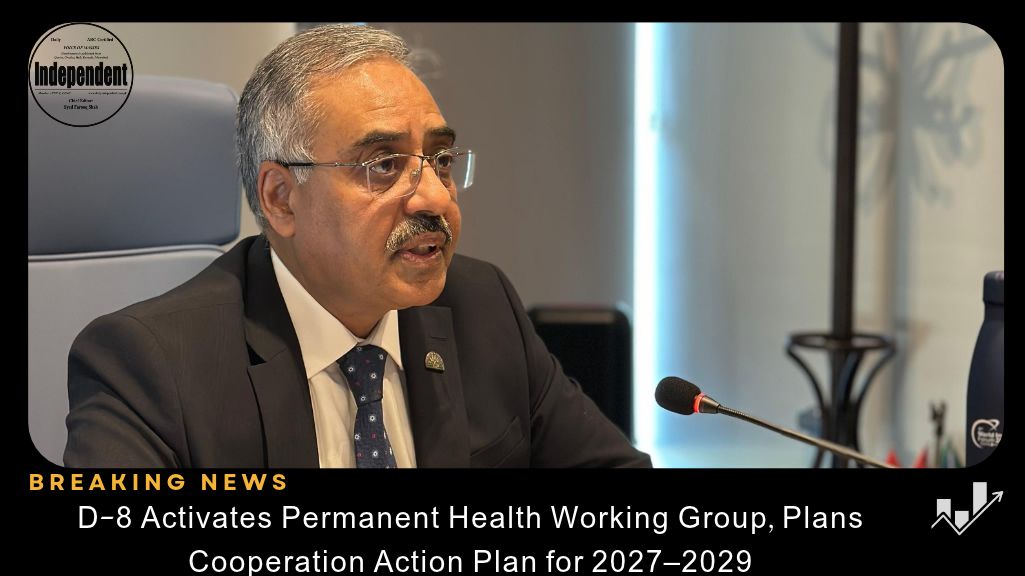
The meeting was chaired by Dr. Aziz Alper Biten, Director General for EU and Foreign Affairs at Türkiye’s Ministry of Health. He emphasized the importance of translating ministerial commitments into practical measures and reaffirmed Türkiye’s readiness to share its expertise and experience with member states, particularly in digital health, pharmaceutical and medical device tracking systems, and capacity-building for healthcare professionals.
In his opening remarks, D-8 Secretary-General Ambassador Sohail Mahmood described health cooperation as strategically important for promoting human security, economic resilience and sustainable development. He appreciated the support of Türkiye’s Minister of Health, Prof. Dr. Kemal Memişoğlu, for expanding cooperation among D-8 countries and acknowledged Türkiye’s commitment to hosting the Second D-8 Ministerial Meeting on Health in 2027.
The Secretary-General highlighted the complementary strengths of member states in pharmaceuticals, vaccines, biotechnology, medical technologies, digital health and public health systems. He stressed the need to utilize these capabilities through joint research, technology partnerships, knowledge-sharing and co-development and co-production initiatives.
He observed that such cooperation could strengthen regional healthcare supply chains, promote self-reliance and deepen South-South cooperation among developing countries.
Following detailed deliberations, the Working Group finalized its Terms of Reference, identifying five priority areas for cooperation: health systems and emergency preparedness; One Health and emerging health threats; population health; health innovation and digital transformation; and health cooperation and sustainable development.
The Terms of Reference will be submitted to the Second D-8 Ministerial Meeting on Health in 2027 for endorsement.
Meanwhile, the D-8 Health and Social Protection Programme, based in Abuja, Nigeria, presented a preliminary mapping study on the healthcare strengths and expertise of member states. The study aims to identify complementary capabilities, gaps in cooperation and potential opportunities for institutional and industrial partnerships.
As part of the immediate follow-up, two knowledge-sharing webinars are planned in the coming weeks. The first will focus on digital health, drawing on Türkiye’s e-Nabız experience, while the second will address pharmaceutical track-and-trace systems and digital health surveillance platforms.
The Permanent Health Working Group will also develop a D-8 Health Cooperation Action Plan for 2027–2029 to facilitate the systematic implementation of the Cairo Declaration and provide a framework for sustained collaboration among member states.
The operationalization of the Working Group establishes a standing institutional mechanism to translate the D-8 health cooperation agenda into tangible projects, technology partnerships and policy coordination.
As the D-8 approaches its 30th anniversary in 2027, the initiative reflects the Organization’s growing emphasis on results-oriented sectoral cooperation, with health emerging as an important driver of industrial development, innovation, economic resilience and collective well-being.
